
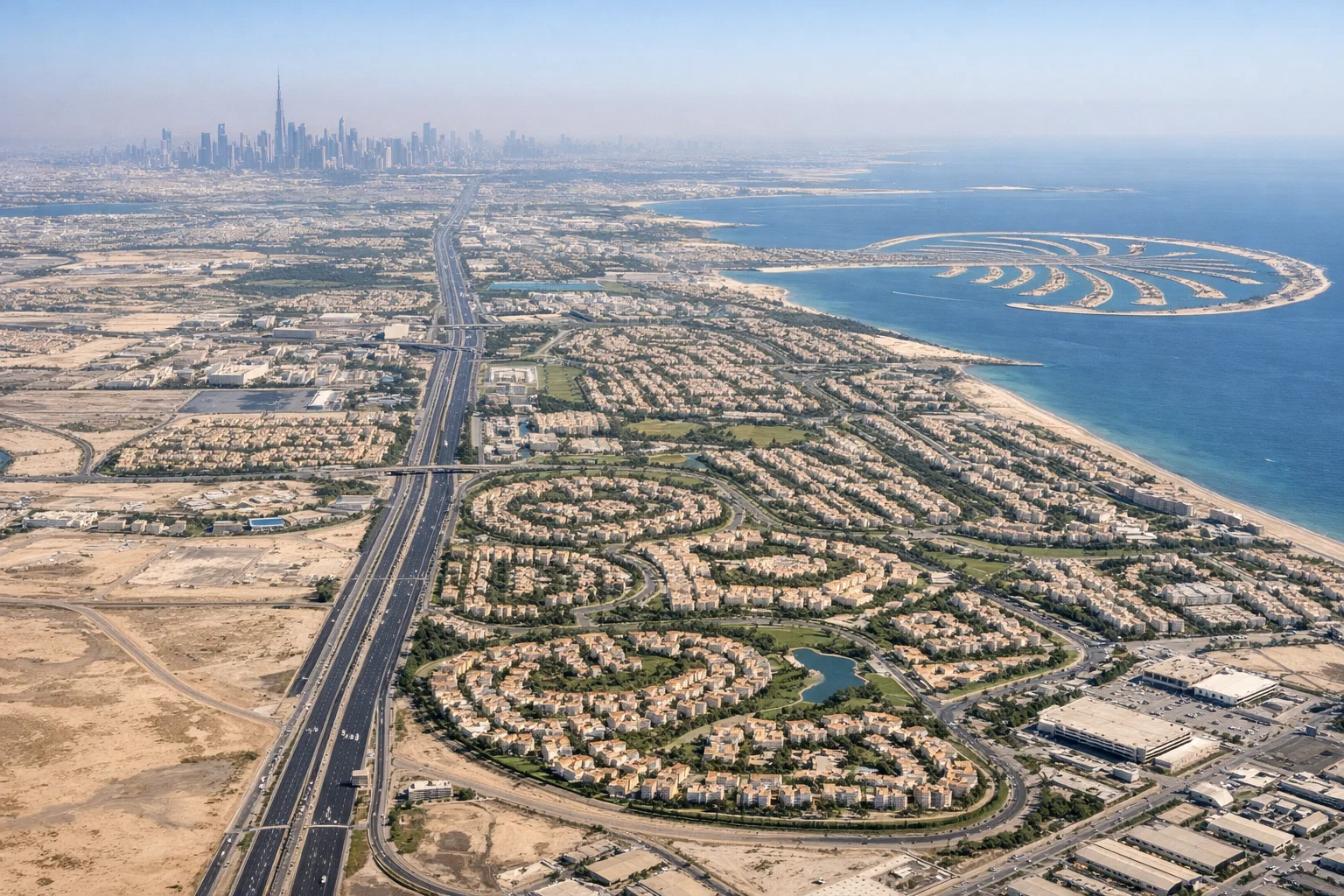

Dubai Is Moving South: Why Dubai South & Palm Jebel Ali Are Emerging as the Next Prime Residential Belt
Dubai’s real estate cycles don’t move randomly.
They move directionally, following infrastructure, master planning, and long-term population strategy.
In 2026 and beyond, one directional shift is becoming increasingly clear:
Dubai’s next phase of prime residential growth is moving south.
Not in a speculative way.
Not as a “future promise.”
But through a combination of confirmed master plans, infrastructure investment, and the type of residential projects now being launched in the area.
This is why Dubai South and the Palm Jebel Ali corridor are no longer being viewed as peripheral — but as early-stage prime.
From Central Density to Strategic Expansion
Historically, Dubai’s prime residential demand concentrated around:
- Downtown / Business Bay
- Dubai Marina / JBR
- Palm Jumeirah
These areas are now:
- Highly priced
- Densely developed
- Limited in future large-scale residential supply
As cities mature, growth doesn’t stop — it repositions.
Dubai’s planning model has consistently followed this pattern:
- Establish a core
- Fully develop it
- Expand outward with better infrastructure and larger master plans
Dubai South represents that next expansion phase.
2. Apartments – Investor Demand Still Favors Liquidity
Dubai South was initially perceived as long-term due to its scale. What has changed is execution visibility.
Key fundamentals now in place or under active development include:
- Strategic positioning near Al Maktoum International Airport (DWC)
- Connectivity to major logistics, aviation, and employment hubs
- Ongoing residential zoning aligned with population growth targets
- A shift from mixed-use and logistics focus toward livable residential communities
This transition matters.
Residential demand does not follow brochures — it follows jobs, access, and long-term livability planning.
3. The Palm Jebel Ali Effect
Palm Jebel Ali is not just another waterfront project. It functions as a pricing and perception reset for the entire southern corridor.
Historically, Palm developments in Dubai have done three things:
- Attracted global attention
- Pulled premium residential demand outward
- Lifted adjacent land values through spillover demand
Palm Jebel Ali introduces:
- Large-scale waterfront planning
- Ultra-low density residential zoning
- A new luxury residential reference point outside the traditional core
As with previous Palm developments, the impact is rarely isolated to the Palm itself.
The surrounding residential zones benefit from:
- Increased desirability
- Higher-quality development launches
- Long-term price anchoring to a premium benchmark
4. Why Prime Off-Plan Residential Is Launching Here Now
Developers do not launch prime residential projects randomly.
They launch where pricing, absorption, and future demand align.
Projects such as Lunaya and Palm Springs emerging in the Dubai South corridor reflect a clear shift:
- From purely affordable housing
- Toward aspirational, end-user-ready residential communities
What defines this new wave:
- Master-planned layouts, not isolated towers
- Focus on livability, not just yield
- Pricing that reflects early-entry positioning, not peak-cycle valuation
This is a key signal.
Prime residential products typically appear before an area becomes fully established — not after.
5. End-User and Investor Demand Are Aligning
One of the strongest indicators of sustainable growth is when end-user demand and investor interest overlap.
In the Dubai South and Palm Jebel Ali corridor:
- End-users are drawn by space, newer communities, and long-term value
- Investors are drawn by entry pricing, future demand visibility, and infrastructure-led growth
This alignment reduces volatility.
Markets driven only by investors move fast — and correct hard.
Markets supported by end-users build depth and stability.
6. What Makes This Different From Past “Next Big Area” Narratives
Dubai has seen many areas marketed as “upcoming.”
What separates Dubai South today is confirmed intent and scale.
Key differences:
- Integrated planning rather than piecemeal development
- Anchor projects (airport, Palm Jebel Ali) with global relevance
- Residential launches designed for real occupancy, not speculation
- A longer development runway aligned with Dubai’s population strategy
This is not a short-term flip narrative.
It’s a positioning narrative.
7. What This Means for Buyers in 2026 and Beyond
For buyers looking ahead, the takeaway is simple:
- Prime residential opportunities rarely appear when an area is already obvious
- The best entry points exist when fundamentals are in place, but pricing hasn’t fully adjusted
Dubai South and the Palm Jebel Ali corridor sit at that intersection.
Not risk-free.
Not speculative.
But strategically early.
Final Thought
Dubai’s growth story is no longer just vertical — it’s directional.
As the city expands southward, the quality of residential projects launching in the area is the clearest signal of what’s coming next.
For buyers focused on the next cycle — not the last one — this is an area worth understanding deeply, not ignoring.