
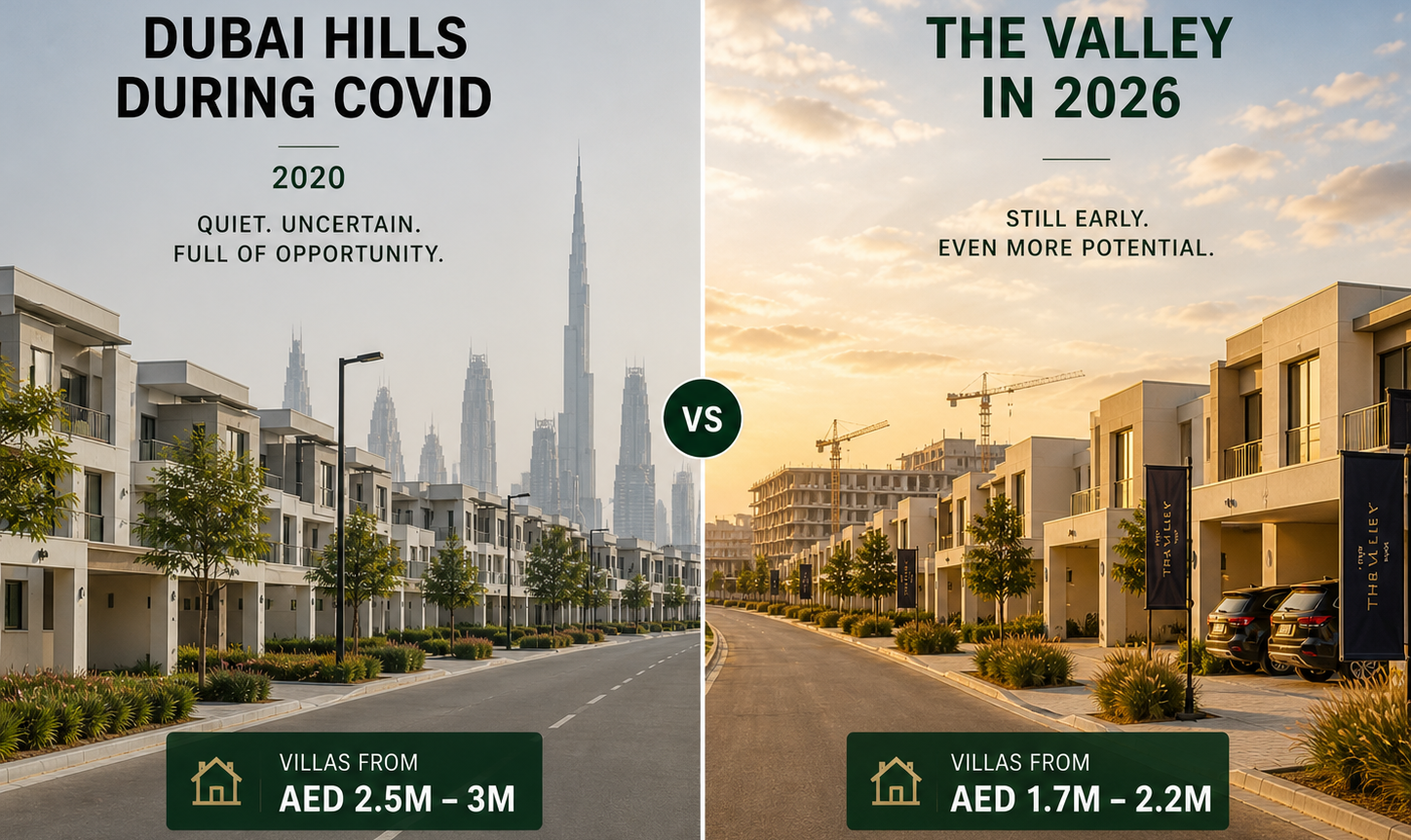

Dubai Hills During COVID vs The Valley in 2026
Most people only recognize an opportunity after it’s already priced in. By then, the easy money has been made, the risk has been absorbed by someone else, and what’s left is the comfort of certainty, at a premium.
There’s a comparison most investors aren’t making right now. And once you see it, it’s hard to unsee.
When Dubai Hills Didn’t Look Like an Opportunity
Go back to 2020. Dubai Hills Estate was built, growing, and available. But nobody was rushing. The market felt uncertain, COVID had rattled confidence across every asset class, and nothing about the moment screamed urgency.
Entry prices reflected that hesitation:
- Townhouses were available around AED 1.3M – 1.5M
- Villas were sitting at AED 2.5M – 3M
And even at those numbers, people held back. They waited for clarity that never quite arrived, because it never does at the beginning.
The Valley in 2026 Feels Familiar
Now look at The Valley by Emaar. Still developing. Still expanding. Still not “fully proven” in the eyes of cautious buyers. And still priced accordingly.
Villas start from around AED 2.5M. For a master-planned Emaar community with infrastructure already in motion, that’s an entry point that won’t exist forever.
The feeling around it? Cautious. Uncertain. “Let’s see how the area develops first.”
But that’s where many buyers focus only on the houses and miss the bigger picture.
The Valley is being designed as a complete lifestyle destination, with amenities that already include:
- Golden Beach and the Town Centre
- Sports Village, padel courts, tennis courts, and fitness zones
- High ropes course and zipline experiences
- Adventure play areas and family recreation spaces
- Meandering rivers, lakes, and Valley Trails
- Canopy Walk, flower farms, orchards, and expansive green spaces
These features aren’t valuable simply because they exist. Their value comes from what they create over time.
Families begin spending weekends within the community. Children grow up using the parks and recreation spaces. Retail follows residents. Schools and services follow demand. Gradually, what was once viewed as an emerging community starts becoming an established one.
That’s exactly how many of Dubai’s most sought-after neighborhoods evolved.
The interesting part is that the ingredients are often visible long before the wider market fully recognizes their value. By the time a community feels complete, the market has usually adjusted its pricing to reflect it. This is why early-stage communities rarely look obvious when the opportunity is still there.
Same Hesitation, Different Words
This is the part worth paying attention to. The situation has changed, different era, different community, different market conditions. But the behavior is identical.
In 2020, the hesitation sounded like: “Let’s wait and see what happens with the market.” In 2026, it sounds like: “Let’s see how the area develops first.”
Different words. Same instinct. Same outcome for the people who acted on it, and the people who didn’t.
What Actually Drove Dubai Hills’ Growth
It wasn’t simply the passage of time. What transformed Dubai Hills wasn’t patience, it was a cascade of completion signals that built on each other until confidence crossed a threshold:
- Families started moving in and the streets came alive
- Parks became active community spaces, not just landscaping on a brochure
- Schools opened and catchment areas formed
- Retail followed footfall, and footfall followed retail
Once enough of those signals stacked up, the narrative shifted from “potential” to “proven.” And when that happens, demand doesn’t gradually increase, it surges. Buyers who had been sitting on the fence suddenly competed for the same units.
The window between “developing” and “established” is shorter than most people expect. And it only looks obvious in hindsight.
How Much Prices Actually Moved
The numbers tell a straightforward story:
- Townhouses that were ~AED 1.4M became AED 4.5M+
- Villas that were ~AED 3M became AED 8M+
That’s not a modest uptick or a gradual climb. That’s a fundamental repricing of what the community was worth once confidence caught up with reality. The buyers who entered during the uncertainty phase captured the full move. Those who waited for comfort entered at the top of it.
Where The Valley Sits in the Cycle
Every strong-performing community goes through the same four stages:
- Uncertainty phase — the market feels risky and few are willing to commit
- Quiet buying phase — prices are still accessible, sentiment is still cautious
- Confidence phase — the community proves itself and conviction builds
- Demand surge — everyone wants in, and prices reflect it fully
The Valley is sitting squarely in stage two. That’s why prices still feel reasonable. That’s why buyers feel uncertain. That’s why urgency isn’t there yet. But that’s also exactly what early-stage communities always look like, right before they don’t.
Most buyers enter at stage four, because that’s when it feels safe. By then, the opportunity has already been captured by everyone who moved during stage two.
Why Early-Stage Communities Always Feel This Way
There’s a structural reason early communities feel uncertain: the evidence that buyers want doesn’t exist yet. Schools aren’t fully open. Retail hasn’t arrived. The parks are there but quiet. The streets feel new.
The very signals people are waiting for are precisely what make a community valuable once they appear, and by then, prices have already moved to reflect them. Waiting for proof is the same as paying for it. You don’t get both.
The Question Is About Positioning, Not Price
The right question isn’t whether AED 1.7M is a good price for a villa today in isolation. The right question is: where does that entry point sit in the community’s development cycle?
Early positioning and late positioning produce fundamentally different outcomes, even at similar price tags. What you’re buying isn’t just the property, it’s the position in the trajectory. And that position only exists at a certain window.
This Is Not a Prediction
The Valley is not guaranteed to become Dubai Hills. Markets don’t repeat on a fixed schedule, and no two communities develop identically. Infrastructure timelines, broader market shifts, and developer execution all play a role. Nothing about this is a certainty.
What can be observed is the behavioral pattern, the hesitation, the waiting, the search for certainty before committing. That pattern has appeared at the early stages of every community that later outperformed. It’s not a guarantee. But it is a signal worth taking seriously.
What Most People Miss About Timing
Back in 2020, buying in Dubai Hills didn’t feel like a smart move. It felt uncertain, early, and unclear. The market was bruised, the community was half-built, and the conventional wisdom said wait.
That discomfort wasn’t a warning signal. It was the condition that made the opportunity real.
The same discomfort exists today around The Valley. And it’s being interpreted the same way, as a reason to pause, to watch, to let someone else go first. For most people, by the time the discomfort is gone, so is the opportunity.
Two Very Different Outcomes
Entering when something feels obvious and entering when it still feels early are not two versions of the same decision. They lead to two entirely different places.
The price tag can look similar on paper. The position in the cycle is not. One puts you ahead of demand. The other puts you inside it. And once you understand the difference, the question isn’t really whether The Valley will develop, it’s whether you’ll be positioned before it does, or after.
Most people miss opportunities not because they weren’t there. But because opportunities don’t look like opportunities at the moment they’re available.
By the time they do, they’re no longer priced the same.