
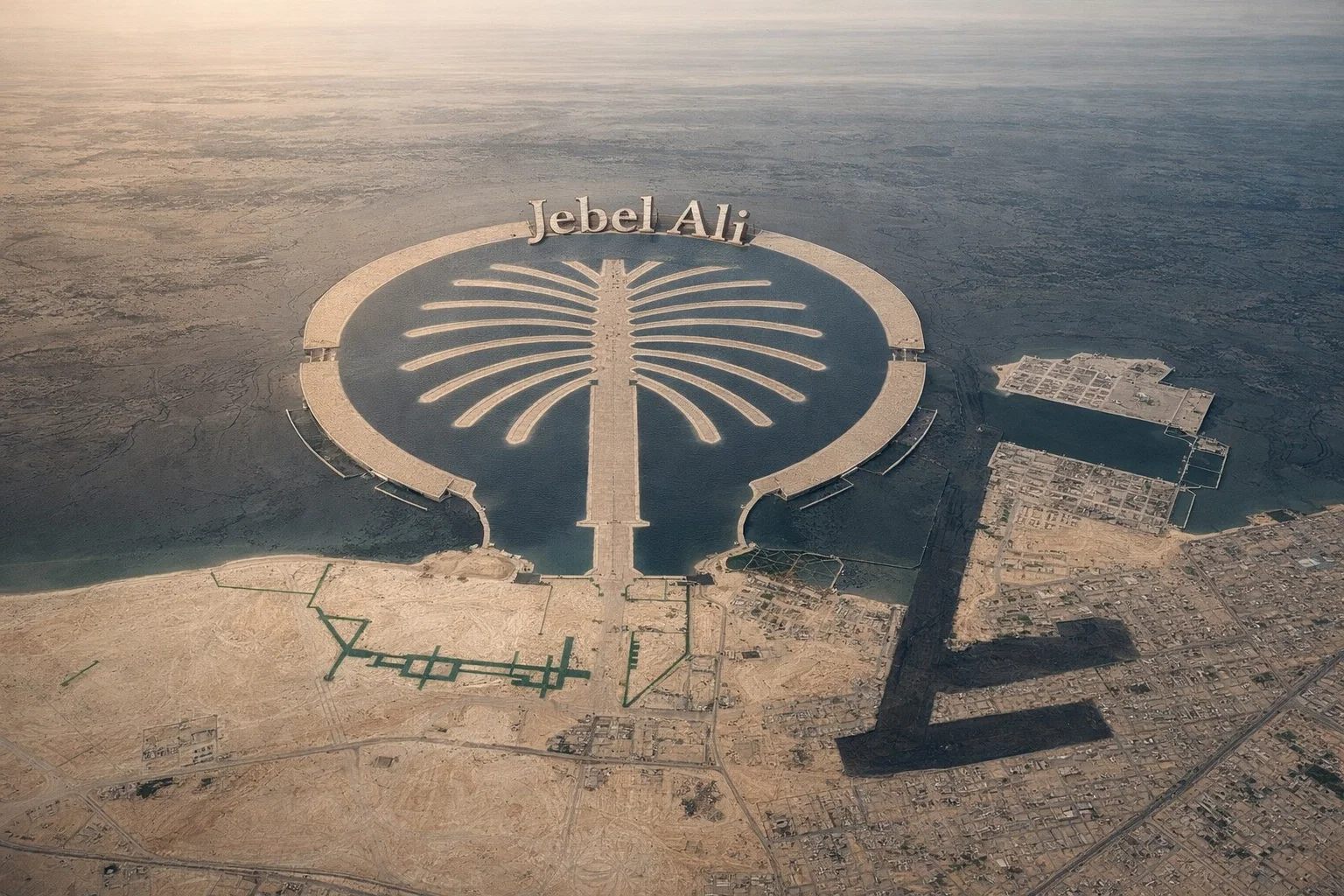

The Palm Jebel Ali Effect: How One Mega Project Reprices an Entire Corridor
In Dubai, landmark projects don’t just create destinations.
They reset perception, pricing, and demand patterns far beyond their borders.
Palm Jebel Ali is not an isolated luxury development.
It is a market signal — and historically, these signals reshape entire residential corridors.
To understand what Palm Jebel Ali means for Dubai South and surrounding communities, you need to look at how Dubai has behaved before — not what’s being marketed now.
1. Landmark Projects Don’t Stay Contained
Dubai’s previous mega-developments followed a consistent pattern:
- Palm Jumeirah
- Downtown Dubai
- Dubai Marina
Each began as a standalone vision.
Each eventually repriced surrounding areas through spillover demand.
The mechanism is simple:
- Global attention increases
- Buyer perception shifts
- Developers upgrade product quality nearby
- End-user and investor confidence follows
Palm Jebel Ali fits this exact blueprint — but at a much larger scale.
2. Why Palm Jebel Ali Is Structurally Different
Palm Jebel Ali is not a replication of earlier Palm developments.
It is designed for modern residential demand, not just iconic imagery.
Key characteristics:
- Significantly larger land mass
- Lower density residential planning
- Long-term phased development
- Integration with Dubai’s southern expansion strategy
This matters because scale determines impact.
Large-scale projects don’t just create demand — they anchor future pricing benchmarks.
3. The Spillover Effect on Dubai South
Villas and apartments behave differently when you want to exit. Villas need a clear end-user buyer pool. Apartments need a clear tenant story + resale depth inside the building.
When a premium reference point is introduced, nearby residential zones benefit in three ways:
- Perception upgrade
Areas once viewed as “secondary” begin to be evaluated through a new lens. - Product evolution
Developers respond by launching higher-quality residential projects to match future demand. - Price anchoring
Entry prices in surrounding areas feel relatively attractive when compared to the premium benchmark.
Dubai South sits directly in this spillover path.
This is why we’re seeing a shift:
- From utility-focused developments
- Toward lifestyle-led, end-user-ready residential communities
4. Why Developers Move First
Developers typically act before pricing fully adjusts — not after.
The emergence of residential projects like Lunaya and Palm Springs in the southern corridor is not coincidental. It reflects:
- Confidence in long-term demand
- Early positioning ahead of broader repricing
- Alignment with infrastructure-led growth
Developers follow feasibility models, not headlines.
Their movement is one of the clearest indicators of what they expect next.
5. End-User Demand Is the Silent Driver
One of the most overlooked impacts of landmark projects is end-user psychology.
End-users don’t need to live on the Palm to feel its effect.
They look for:
- Proximity without premium pricing
- Newer communities with long-term value
- Areas aligned with future city planning
This demand is slower — but far more stable.
When end-users enter a market, it reduces volatility and strengthens long-term pricing support.
6. What This Means for Investors
For investors, the Palm Jebel Ali effect is not about immediate price spikes.
It’s about positioning before repricing becomes obvious.
Historically, the strongest returns come from:
- Buying near future anchors
- Entering before mass sentiment shifts
- Holding through infrastructure and perception upgrades
Dubai South currently sits in that window.
7. What This Is — and What It Isn’t
This is not a “quick flip” story.
And it’s not a guarantee narrative.
It is:
- A structural growth story
- An infrastructure-led positioning play
- A long-term residential demand thesis
Markets driven by landmarks mature in phases — and early understanding matters.
Final Thought
Palm Jebel Ali will eventually be discussed as a turning point in Dubai’s southern expansion.
The only question for buyers is timing:
- After prices adjust and demand is obvious
- Or before positioning becomes crowded
The Palm itself may be premium.
But the opportunity often lies just beyond it.