

Dubai 2026: The Exit Liquidity Map – Where Can You Actually Sell?
In Dubai real estate, most investors focus on one question:
“What’s the ROI?”
But in 2026, the smarter question is:
“How fast can I exit?”
Because profit on paper means little if your asset sits unsold for months.
As supply increases in certain communities and end-user behaviour becomes more selective, exit liquidity — the speed and ease at which a property can be resold — will quietly determine who wins and who gets stuck.
Here’s how to understand Dubai’s liquidity landscape heading into 2026.
What Is Exit Liquidity – And Why It Matters
Exit liquidity refers to how quickly a property can be sold at market value without heavy discounting.
In practical terms, this depends on:
- End-user demand depth
- Unit configuration demand (1-bed vs 2-bed vs villa type)
- Community maturity
- School and infrastructure pull
- Upcoming supply pipeline
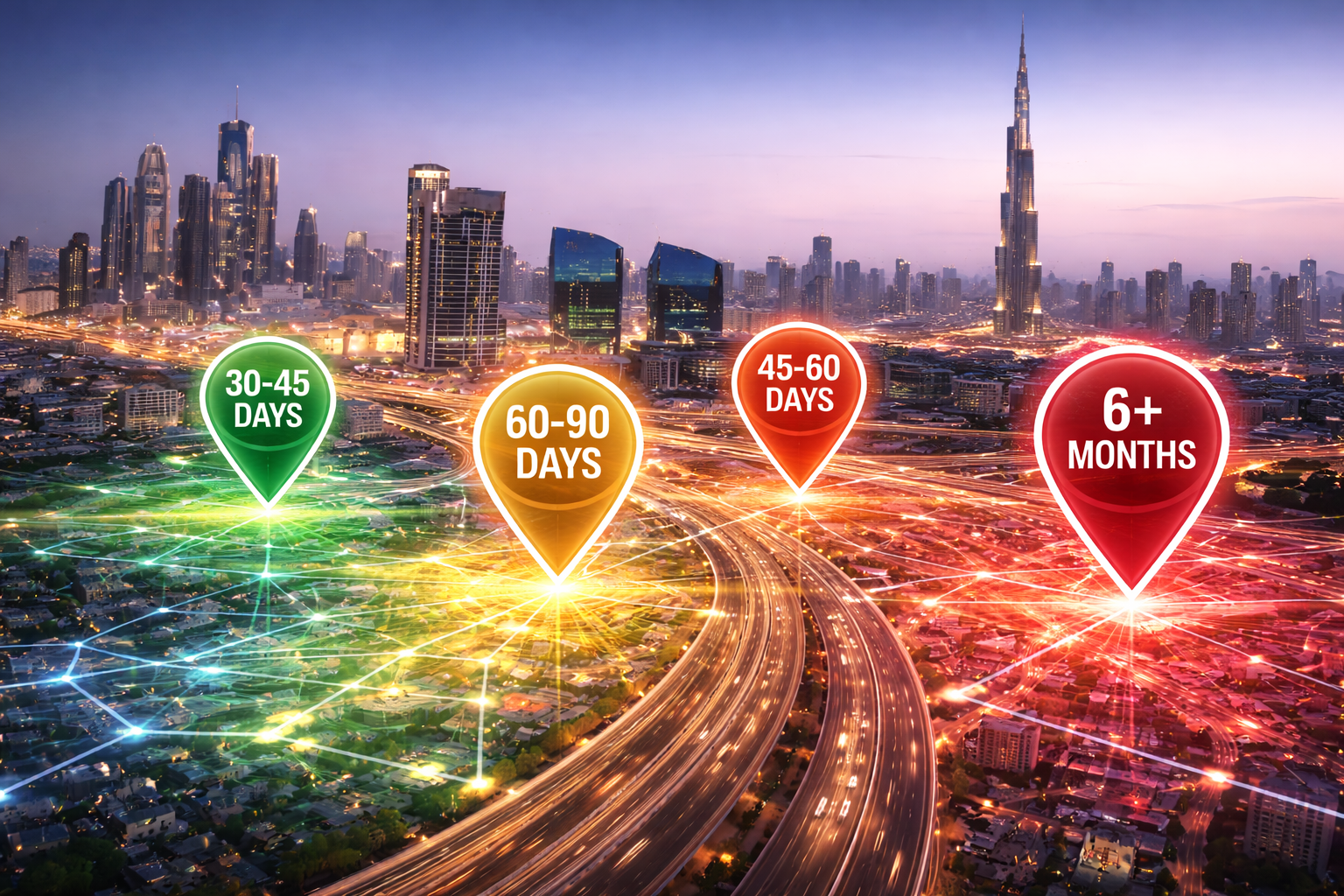
Two properties can have identical rental yields — yet one may sell in 30 days while the other takes 6+ months.
Liquidity determines leverage.
Liquidity determines negotiating power.
Liquidity determines stress levels.
High Liquidity Communities (Shorter Resale Cycles)
Communities with strong end-user depth and balanced supply tend to move faster in resale markets.
These typically include:
- Mature family communities with limited new villa supply
- Established apartment zones with proven tenant absorption
- Areas supported by schools, retail, and transport connectivity
In these locations, resale cycles often fall within 30–60 days when priced correctly.
Why?
Because demand is not purely investor-driven. It is end-user backed — and end-users move for lifestyle, not speculation.
Medium Liquidity Zones (Selective Demand)
These areas can perform well — but are more sensitive to pricing and positioning.
Typically characterized by:
- Larger upcoming supply
- Multiple competing towers
- Similar layouts across developments
- Higher investor concentration
Resale here may take 60–120 days, depending on market sentiment.
Strategy matters more in these zones.
Low Liquidity Risk Areas (Exit Can Be Slow)
Some communities experience slower resale cycles due to:
- Heavy oversupply
- Weak end-user depth
- Over-reliance on short-term hype
- High service charges affecting affordability
In these cases, properties may sit for 6+ months, often requiring price adjustments to move.
These are not necessarily “bad” areas — but they require careful entry timing and pricing discipline.
What Drives Liquidity in 2026 Specifically
As Dubai evolves, several 2026-specific factors will shape exit velocity:
- End-User Migration Patterns
Families are increasingly moving toward larger living spaces and master-planned communities. - Supply Pipeline Awareness
Areas with controlled launches tend to retain pricing power better than those with aggressive releases. - Service Charge Sensitivity
Higher service charges directly impact buyer affordability and net returns, reducing resale attractiveness. - Infrastructure Completion
Completed infrastructure creates confidence. Promised infrastructure creates speculation.
Liquidity favours certainty.
How Smart Investors Position Themselves
Before buying in 2026, ask:
- Who is my likely buyer in 2–3 years?
- Is demand investor-driven or end-user driven?
- What competing supply is entering the market?
- If I needed to sell quickly, could I?
The best investors do not only calculate ROI.
They calculate exit probability.
Final Thoughts: Profit Is Made on Exit
Dubai remains one of the most dynamic real estate markets globally. But as the market matures, sophistication increases.
The next wave of successful investors in 2026 will not simply buy where prices are rising.
They will buy where:
- Demand depth is real
- Supply is controlled
- Resale velocity is strong
Because in real estate, you don’t realize gains when you buy.
You realize them when you sell.