

Dubai Commercial Freehold vs. Leasehold: What’s Actually the Difference?
When investing in Dubai commercial property, one of the first questions buyers often ask is whether an asset is freehold or leasehold. It is an important question, but the label alone does not determine whether a commercial property is a good investment.
In Dubai’s industrial and logistics market, long-term land-lease structures are common. Some of the city’s strategically positioned industrial and commercial districts operate through long-term leases and other land rights, putting warehouses, factories and logistics facilities close to major highways, ports, airports and established business corridors.
For an investor, the more useful question is not simply “Is this leasehold?” It is “What exactly am I buying, how much tenure remains, what income does the asset produce, and what rights and obligations are attached to it?”
Freehold vs Leasehold: What Is Actually Different?
Freehold and leasehold represent different forms of property rights.
With freehold, the investor owns the registered property interest without a fixed expiry. With leasehold, the investor’s property rights are connected to land held for a specified period and subject to the underlying land agreement.
That does not automatically make leasehold inferior. The investment case depends on the terms of the lease, remaining tenure, location, income, operating costs, permitted use, tenant demand and resale prospects.
For commercial investors, understanding the structure behind the asset is therefore more important than relying on a simple freehold-versus-leasehold assumption.
Why Leasehold Is Common in Dubai’s Industrial Market
Industrial land is strategic infrastructure. Warehouses and factories need large parcels of land in locations that provide efficient access to ports, airports, highways, logistics corridors and manufacturing clusters.
Dubai has developed major industrial ecosystems around these requirements. Long-term leases and other land rights can allow businesses and developers to establish facilities on strategically located land while maintaining a structured approach to land use and development.
This helps explain why leasehold structures can be found across important industrial and logistics districts. A leasehold industrial asset is therefore not automatically a secondary or undesirable property simply because the land interest is time-limited.
Dubai’s Major Industrial & Logistics Locations
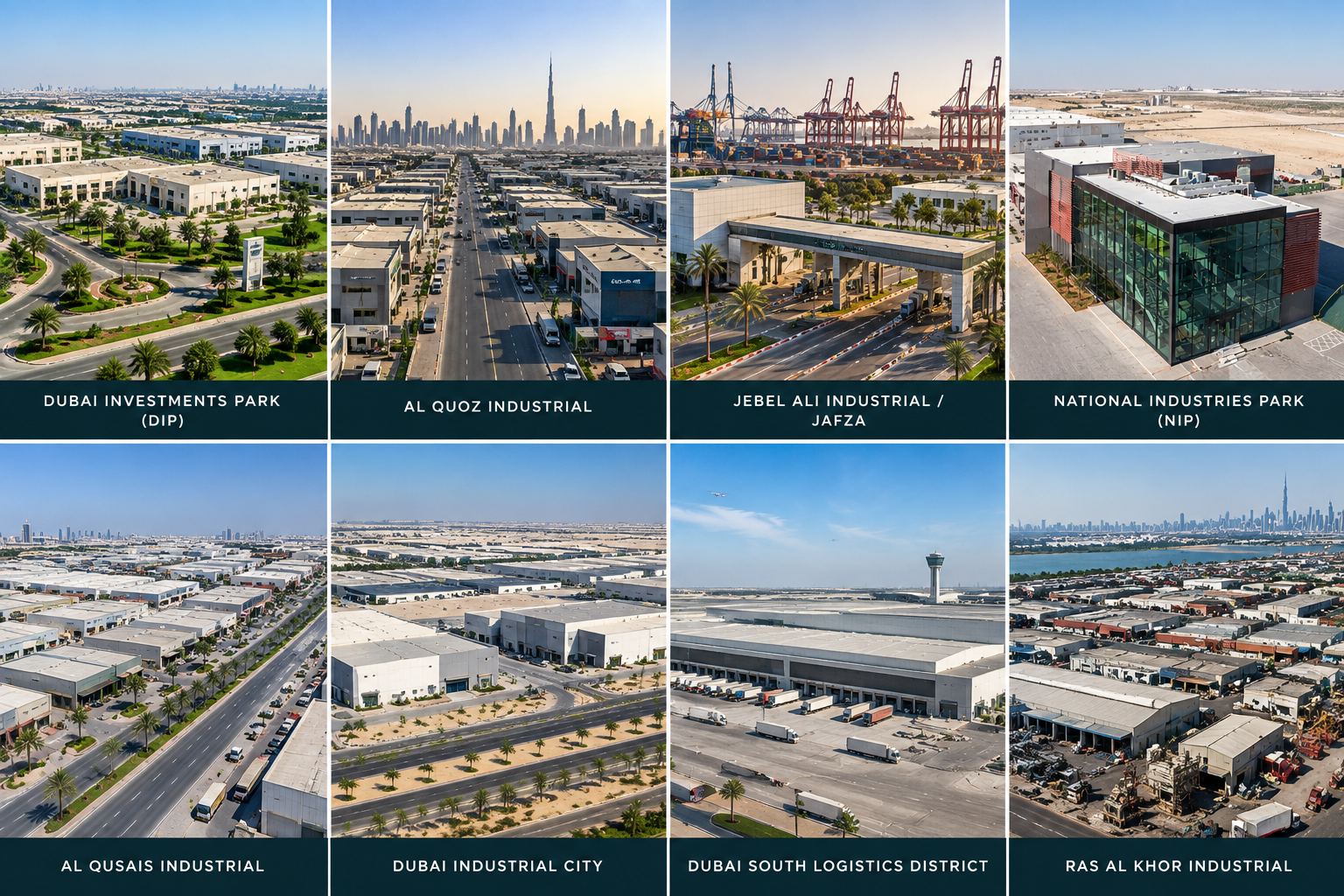
Dubai’s industrial and logistics landscape includes several established and strategically positioned districts:
• Dubai Investments Park (DIP)
• Al Quoz Industrial
• Jebel Ali Industrial / JAFZA
• National Industries Park (NIP)
• Al Qusais Industrial
• Dubai Industrial City
• Dubai South Logistics District
• Ras Al Khor Industrial
These locations benefit from proximity to major transport infrastructure, population centres, ports, airports and logistics corridors.
However, tenure can vary by individual plot and asset. Investors should review the specific title, lease agreement and registered rights rather than assuming every property within a named district has the same ownership structure.
Dubai Investments Park: A Practical Example
Dubai Investments Park, commonly known as DIP, provides a useful example of how long-term land leasing can operate within Dubai’s industrial market.
The source material notes that DIP’s original development land was obtained under a 99-year long-term lease from the Government of Dubai, while the development historically offered long-term lease options of up to 99 years for industrial and commercial projects.
As a result, warehouses within DIP can be bought and sold with substantial remaining land-lease periods.
This is why the statement “It is leasehold” does not provide enough information to judge the investment. The investor needs to understand how much tenure remains, what rights are transferable, what the asset produces and how the underlying agreement affects the property.
JAFZA and National Industries Park
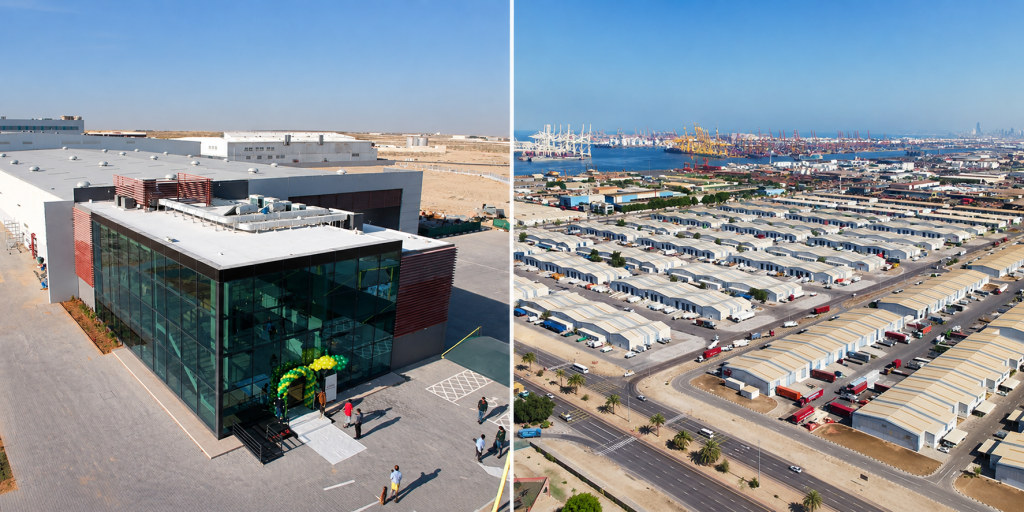
JAFZA and National Industries Park demonstrate another important side of Dubai’s industrial model: businesses need strategically located land and infrastructure to support manufacturing, storage and logistics.
JAFZA offers infrastructure-ready land through short- and long-term leases, enabling companies to develop manufacturing, storage and logistics facilities.
National Industries Park offers long-term industrial land leases, generally starting from 20 years, and is positioned within Dubai’s logistics corridor with access to Jebel Ali Port, Al Maktoum International Airport and national highways.
The important lesson is that leasehold status should be assessed together with location, infrastructure, tenure and business demand. A leased property in a strategically important industrial hub can still have strong commercial fundamentals.
The Leasehold Model Continues in New Dubai
Long-term land leasing is not simply a legacy feature of Dubai’s older industrial areas. The model also continues to play a role in newer logistics and manufacturing hubs.
Dubai Industrial City has entered into major long-term land arrangements for large industrial developments. Dubai South’s Logistics District has similarly marketed master-planned development plots with long-term leasehold titles alongside warehouses and built-to-suit facilities.
As Dubai continues to develop logistics, aviation and manufacturing ecosystems, long-term land rights remain part of the commercial property landscape.
For investors, this makes it even more important to understand the exact tenure and contractual structure of the specific property rather than treating all leasehold assets as the same.
Is Freehold Always the Better Investment?
Not necessarily.
Consider two hypothetical commercial investments:
Freehold office — Net return: 6
Leasehold warehouse — Long remaining tenure, prime logistics location, strong tenant demand, net return: 10%
Which is the better investment? The word “freehold” alone cannot answer that.
A commercial investor should compare:
• Yield
• Remaining tenure
• Location
• Land rent
• Renewal terms
• Tenant demand
• Permitted use
• Resale potential
• Operating and ownership costs
Commercial property is ultimately an income-producing asset. The ownership structure is one part of the analysis, not the entire analysis.
A leasehold property with a strong location, substantial remaining tenure and sustainable income may have a more compelling investment case than a freehold asset with weaker income or demand.
What Should You Check Before Buying Leasehold?
Before buying a warehouse, factory, labour accommodation property or another leasehold commercial asset, investors should go beyond the headline price and ask detailed questions about the underlying rights.
Key questions include:
1. How many years remain on the lease?
2. Who owns the underlying land?
3. Can the interest be transferred?
4. Is renewal available?
5. What is the annual land rent?
6. What activity is permitted?
7. Are all structures approved?
8. What NOCs are required?
9. What documentation will be provided after transfer?
These questions help an investor understand what they are actually acquiring and what obligations may continue after the transaction.
A good leasehold asset with the right structure can be a compelling commercial investment — but the details need to be understood before committing capital.
The Biggest Dubai Commercial Property Myth
One of the simplest assumptions in commercial real estate is:
FREEHOLD = GOOD.
LEASEHOLD = BAD.
The Dubai industrial market shows why that approach is too basic.
Major industrial and logistics ecosystems across areas such as DIP, JAFZA, National Industries Park, Dubai Industrial City and Dubai South use long-term land rights as part of their development structures.
These properties are positioned around the fundamentals businesses actually need:
• Location
• Access
• Tenure
• Income
• Demand
• Return
A strategically located leasehold warehouse with more than 50 years remaining and a strong yield may be a more compelling investment than a lower-yielding freehold commercial asset.
The right comparison is not freehold versus leasehold in isolation. It is the complete investment proposition.
The Winforth Commercial Investor Checklist
Before making a commercial property decision, assess the asset as a whole.
OWNERSHIP — What legal interest are you acquiring?
TENURE — How much time remains, and what are the renewal terms?
LOCATION — How strategically positioned is the property for its target businesses?
INCOME — What is the realistic net return after relevant costs?
LAND RENT — What ongoing land-related costs apply?
PERMITTED USE — What activities and uses are allowed?
TENANT DEMAND — Who is likely to occupy the property, and why?
RESALE — Who is the likely future buyer?
DOCUMENTATION — What approvals, NOCs and transfer documents are required?
This approach allows investors to move beyond labels and focus on the fundamentals that actually influence commercial property performance.
Conclusion
Freehold and leasehold are different property structures, but neither word automatically determines whether a commercial investment is good or bad.
Dubai’s industrial market provides numerous examples of strategically important locations where long-term land rights support warehouses, factories, logistics facilities and other commercial developments. The investment question is therefore more nuanced.
Look at the location. Understand the remaining tenure. Review the land rent and renewal terms. Confirm permitted use and approvals. Analyse tenant demand and net income. Then consider how easily the property could be sold in the future.
In commercial real estate, the strongest decisions come from understanding the fundamentals behind the asset — not simply the label attached to its ownership structure.
DON’T BUY THE LABEL.
BUY THE FUNDAMENTALS.
Speak with Winforth Luxury Real Estate’s commercial property specialists to explore commercial and industrial opportunities in Dubai.